
Shopify Pokemon Cards: What the Market Shopify TCG Looks Like Right Now
Selling Shopify Trading Card Games like Pokémon cards seems straightforward until you actually try it. List the products, take photos, and ship the orders. Simple, right?
Not quite.
Trading cards – whether Pokémon, MTG, sports cards, or any other TCG – are one of the trickiest niches to run on Shopify. Prices change weekly. Buyers are suspicious of fakes. A booster box that costs $120 today might be worth $60 next month after supply catches up. And one bad review about a damaged or counterfeit card can follow your store for years.
This guide covers everything you need to know to build a Shopify TCG store that works: catalog setup, inventory headaches, trust signals, SEO, shipping, and marketing. It’s written for merchants who are serious about the hobby and want to build something that lasts.
Trading Card of Shopify Pokemon Cards
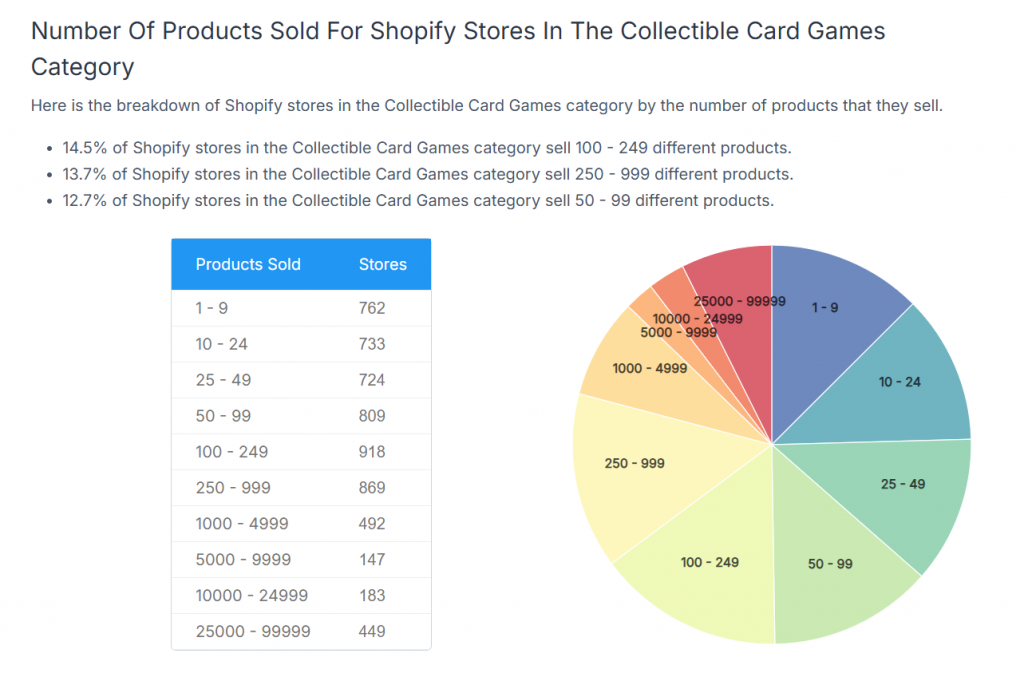
As of early 2026, there are over 6,300 active Shopify stores in the Collectible Card Games category. That number has been climbing roughly 12–13% per quarter, with a spike of around 200% year-over-year in 2025 Q2. New stores are still launching every day – five new card shops went live in the last week of March 2026 alone.
This isn’t a niche for a handful of hobbyists anymore. It’s a real industry.
What’s Being Sold
Shopify Pokémon cards and TCG products come in a few main forms:
- Sealed products – booster boxes, ETBs, booster packs, theme decks, and special edition collections
- Singles – individual cards sold by set, rarity, condition, or format playability
- Graded cards – cards submitted to PSA, Beckett, CGC, or SGC and returned in protective slabs with an official grade
- Supplies – sleeves, binders, top loaders, storage boxes
- Custom and novelty cards – a growing segment that includes AI-generated and personalized card products
Most stores fall into one of two models: multi-line stores carrying Pokémon, MTG, Yu-Gi-Oh!, and sports cards all under one roof, or single-focus stores that specialize in one game or one format (like high-end graded cards only).
The Numbers Behind the Market
As of March 2026, there are 899 active Shopify stores selling trading card products – and that number keeps climbing. New stores launch every week across the US, UK, Australia, and beyond.
The US dominates, making up 41% of all trading card stores on Shopify. Australia (9%), India (8%), and the UK (8%) follow behind (source: EachSpy, March 2026).
Margins vary depending on what you sell. Sealed products and graded cards can reach 40–70% when sourced from the right suppliers. Singles tend to sit lower, around 10–30%, since live market rates on TCGplayer and eBay heavily influence pricing
The global trading card market behind all of this is substantial:
| Category | Market Size | Growth Rate |
|---|---|---|
| Pokémon TCG | $4.6 billion | +35% YoY |
| Sports Cards | $3.2 billion | +42% YoY |
| Magic: The Gathering | $2.1 billion | +28% YoY |
| Yu-Gi-Oh! | $1.5 billion | +18% YoY |
These aren’t niche numbers. And with new stores still launching weekly – five new card shops went live in the final week of March 2026 alone – the market shows no signs of slowing down.
What Makes This Niche Different
Selling Shopify Pokémon cards or any TCG product comes with challenges you won’t find in standard e-commerce.
Grading changes everything
The same Pokémon card in different conditions can vary in value by 60x. A Base Set Charizard graded PSA 2 sells for around $3,000. The same card at PSA 10 sells for $180,000+. That gap means condition communication isn’t optional – it’s central to the entire business.
Inventory is volatile
New set releases create sudden spikes in demand. Popular Pokémon expansions regularly sell out within hours of launch. Stores without solid supplier relationships spend a lot of time managing the disappointment caused by out-of-stock conditions.
Preorders are risky if mishandled
Distributors cap allocations on popular sets, sometimes severely. Stores that accept more preorders than they can fulfill face chargebacks, angry customers, and reviews that follow them for years. The successful stores are transparent about allocation limits before buyers commit.
Buyers are skeptical
Counterfeit Pokémon cards are a known problem. Resealed booster boxes exist. A store that doesn’t clearly signal legitimacy – through authorized retailer badges, detailed condition photos, honest return policies, and a visible human presence – will struggle to earn first purchases from cautious collectors.
How To Start With Pokémon Cards on Shopify?
Starting a Pokémon card store on Shopify isn’t complicated – but a few early decisions will save you a lot of headaches later. Here’s what to sort out before you open.
Pick What You’re Selling
Not all card stores work the same way. The products you choose to sell will shape everything else – your inventory system, your pricing, even how much time you spend on customer service.
Sealed products (booster boxes, ETBs, bundles) are the easiest place to start.
One product, one SKU, no condition grading needed. The downside is that popular Pokémon sets sell out fast. Without good supplier relationships, you’ll constantly be chasing stock during big releases.
Singles take more work but build loyal customers.
A collector completing a master set or building a competitive deck will come back to your store again and again. The tradeoff is inventory complexity – a serious singles operation can run into thousands of individual SKUs.
Services like buy/sell/trade are worth adding once you’re established.
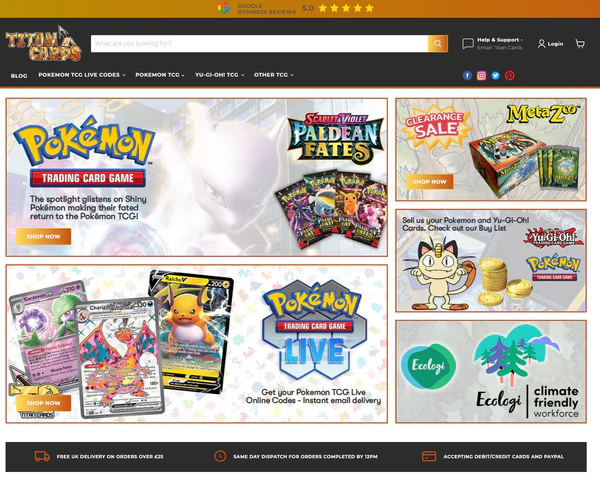
A buylist page turns your store into a destination, not just a shop. Collectors who want to sell their cards now have a reason to visit – and many end up buying something while they’re there.
Start with whatever fits your current inventory and bandwidth. You can always add the other models as the store grows.
Build Trust Before You Expect Sales
New stores in this niche face an uphill battle. Buyers have seen fake cards, resealed boxes, and damaged singles shipped in plain envelopes. They’re cautious – and they should be.
A few things that help:
Write an About page. Say who you are, how long you’ve been in the hobby, and why you started the store. Collectors buy from people they feel are part of the community, not from anonymous storefronts.
Be upfront about your return policy. Sealed product is typically final sale – once a box is opened, it can’t be resold as sealed. That’s not a scam, it’s just the nature of collectibles. State it clearly on your product pages, not just in a buried policy tab. Something like: “Sealed products are final sale. If your order arrives damaged, contact us within 48 hours with photos.” Buyers who see this upfront actually feel more comfortable, not less.
If you’re an authorized retailer, say so. An authorized retailer badge from Pokémon Company International or Upper Deck tells buyers your product is coming from legitimate channels. It’s one of the strongest trust signals you can have in this niche.
Set Up Your Shopify Pokemon Cards Catalog Properly From the Start
A confusing catalog loses buyers fast. Organize your collections so that anyone landing on your store for the first time can find what they want in two clicks.
A simple structure that works:
- Pokémon Cards – Sealed / Singles / Graded
- Supplies – Sleeves / Top Loaders / Binders
- Services – Buylist / Grading Submissions
If you’re also selling other TCGs or sports cards, add those as top-level categories too.
One thing to get right early: if you sell both individual packs and full booster boxes, your inventory counts are linked. Sell a box of 36 packs and you’ve technically sold 36 packs too. Shopify won’t handle that automatically. Use an Inventory app to connect those SKUs, or track everything in packs and build boxes as bundles on top. Pick one approach and stick with it – mixing methods causes overselling.
Start Marketing Inside the Community
Hard-sell ads don’t land well with collectors. What works is showing up where the community already is.
Post pack openings on TikTok or YouTube. Share photos of new inventory arriving. Repost customer pulls. This kind of content fits naturally into how collectors already spend their time online – it doesn’t feel like advertising because it isn’t.
Build your email list from the start. Collectors respond well to restock alerts and preorder announcements because scarcity is real in this hobby. An email that says “Scarlet & Violet booster boxes just came in” will get opened.
Discord is worth considering once you have a small following. A lot of serious TCG buyers spend more time on Discord servers than on Instagram. A store server where collectors can talk about cards and get early access to drops is a genuine loyalty tool.
Pareto Can Help To Stop Scalpers From Clearing Your Inventory
You finally secure an allocation of a high-demand set. You list it. Within minutes, it’s gone – bought out by two or three accounts before most of your regulars even saw it.
That’s not a sales win. That’s a problem.
Those buyers aren’t collectors. They’re resellers who’ll flip your product on eBay at a markup while your actual customers get nothing. And when your regulars check back and find empty stock, they don’t wait around – they find another store.
It happens faster than most new store owners expect. One viral Pokémon set, one Reddit post pointing to your shop, and a handful of bulk buyers can wipe out weeks of inventory in under an hour. Your regulars miss out. Your reputation takes the hit. And you’re left explaining to disappointed customers why it sold out before they had a chance.
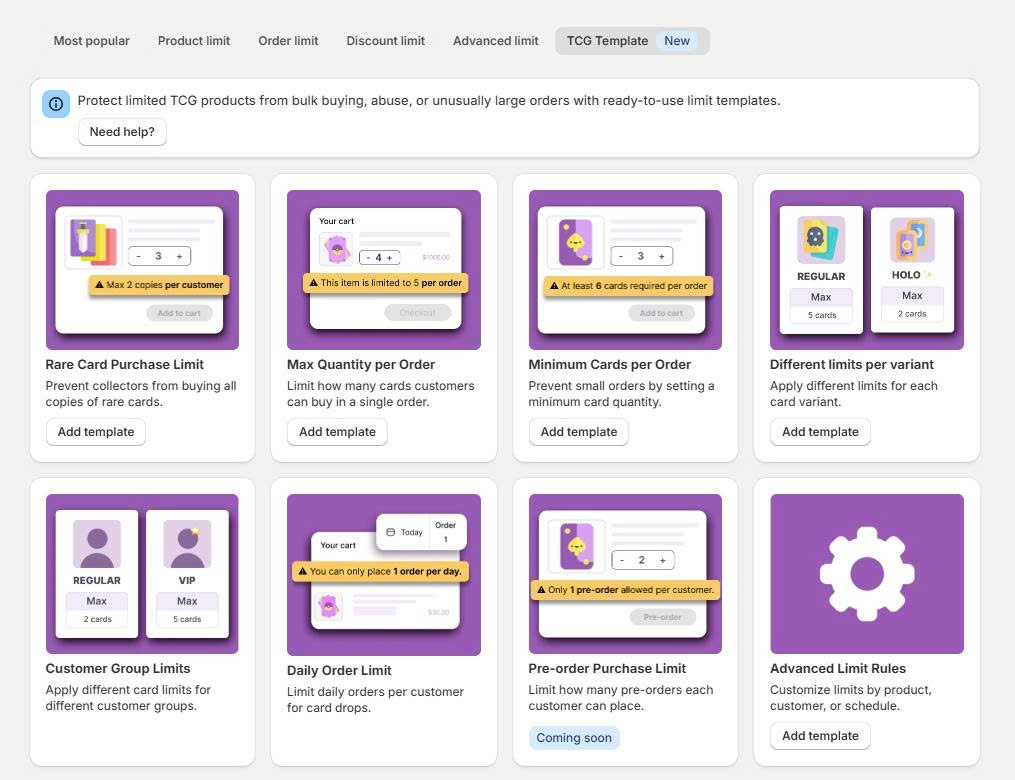
Pareto ‑ Order Limits Quantity is built exactly for this situation. Instead of building your rules from scratch, you start from a TCG-ready setup that already covers the most common scenarios: capping booster box purchases per customer, limiting singles during a restock, or locking down a new set release to one per account. Pick a template, adjust the numbers, and you’re live in minutes. Here’s what this app lets you do:
- Limit purchases per customer – Set a max quantity per order, or a lifetime limit, so the same account can’t come back and grab more
- Schedule limits automatically – Rules activate when your drop goes live and turn off when it ends. No manual switching
- Enforce at checkout – Limits hold even through Shop Pay and other express payment methods. No bypasses
- Target the right buyers – Apply different rules by customer tag, B2B or B2C status, or market. Wholesale and retail buyers play by different rules, automatically
- Create urgency for real collectors – A low stock counter on the product page shows how little is left, nudging the right buyers to act fast
- Catch anything that slips through – Shopify Flow integration flags suspicious orders, tags accounts, or alerts your team before the order ships
No code required. No developer needed. Just rules that hold.
Final Words
Nearly 900 trading card stores are on Shopify right now, and more launch every week. Most sell the same products at similar prices. The ones that last aren’t necessarily the biggest or cheapest – they’re the ones collectors feel safe buying from. Build that trust early, earn it consistently, and you won’t just make sales. You’ll build a store people come back to.