
Summer Promotion Ideas [2026 Trends Updated]
Summer used to be the slow stretch on the retail calendar. Not anymore. If you run an online shop, the right summer promotion ideas can turn the warm months into one of your strongest revenue windows of the year. This guide walks you through what works, the data behind it, and the tools that make each campaign easy to launch.
What is a summer sale and why does it matter?
A summer sale is a seasonal event where retailers and online shops offer discounts, bundles, or special deals during the summer months. These usually run from late May through August. Unlike a one-day flash event, a summer sale can stretch across weeks and build around big cultural moments like Memorial Day, Father’s Day, the 4th of July, Amazon Prime Day, and back-to-school shopping.
But that simple definition hides what’s really happening. For ecommerce merchants, summer has shifted from a sleepy season into one of the most important selling windows of the year. Shoppers spent $117 billion more in the first half of 2025 than in the same period of 2024, which shows that summer spending stays strong even when people are careful with money. Online sales made up 23.1% of total U.S. retail in 2025, up from 22.8% in 2024. The Census Bureau also reported that Q1 2026 ecommerce was already up 9.7% from Q1 2025, so the online channel keeps growing year after year.
![Summer Promotion Ideas [2026 Trends Updated]](https://paretoaov.com/wp-content/uploads/2026/06/image-1024x456.png)
The takeaway is simple. Summer is no longer the quiet gap between peak seasons. It’s a peak season of its own, and the merchants who plan early are the ones who capture the most revenue.
Summer selling by the numbers
Before you pick your tactics, it helps to see the size of the opportunity.
Amazon Prime Day 2025 broke records
Amazon ran Prime Day 2025 as a four-day event from July 8 to July 11, the first time it stretched the sale to four days. The results were big:
- $24.1 billion in U.S. online sales across all retailers during the four days, beating Adobe Analytics’ forecast of $23.8 billion.
- The first day alone hit $7.9 billion across all retailers, up nearly 10% from the year before.
- The top categories were apparel and shoes (30%), household essentials (29%), home goods (26%), health and wellness (26%), and beauty (25%).
Global ecommerce keeps climbing
- Global online sales should reach $6.86 trillion by the end of 2025, with $7.89 trillion expected by 2028.
- The global average order value (AOV) sits at about $150 in late 2025, a 3.08% rise from 2024.
- AOV peaked in April and May 2025, reaching $175 to $177. That makes the spring-into-summer window the most valuable per-order period of the year.
- A major 2025 summer-shopping entity (Prime Day Buy now, pay later BNPL was 8.1% of orders / $2B).
- On average, shoppers buy around five products per order, often to clear free-shipping thresholds.
Shoppers are cautious, but still buying
Summer 2025 was shaped by price sensitivity. A Trax Retail survey found that 46% of shoppers cut back on summer spending because of rising costs.
- 66% of price-sensitive shoppers switched to cheaper or generic brands.
- 53% leaned on discount stores.
- 48% delayed bigger purchases.
This isn’t a sign to slash prices everywhere. It’s a sign to show value clearly. People are still spending. They just want a reason to feel smart about it. Good bundles, tiered pricing, and well-timed deals give them that reason.
6 Summer promotion ideas that actually convert
The best summer marketing campaigns share three traits. They’re tied to a moment, like a holiday or a heatwave. They reduce friction, so it’s easy to buy the right amount. And they create urgency through deadlines or limited stock.
Here are the summer sale ideas worth building your season around.
Seasonal discount campaigns
The simplest summer sale strategy is a seasonal discount: a percentage or fixed amount off, tied to the summer window. Done right, a seasonal discount doesn’t eat your margin. It speeds up purchases people were going to make anyway, and it pulls in new buyers who just needed a nudge.
A few best practices:
- Tie discounts to a specific event instead of a generic “summer sale.” A “4th of July Weekend Sale” or “End of Summer Clearance” lands better than vague seasonal messaging.
- Try a weather-triggered offer. One creative summer sale example: take 5% off for every degree above 100°F. Offers like this earn social shares and press attention on their own.
- Schedule discounts in advance. Setting start and end dates ahead of time removes stress during your busiest weeks. It also keeps an expired deal from running by accident.
Key dates to anchor your promotions:
- Memorial Day weekend (late May)
- Father’s Day (third Sunday in June)
- Juneteenth (June 19), a chance for cause-based campaigns
- 4th of July
- National Flip Flop Day (June 20), niche but very shareable
- Prime Day (mid-July, varies by year)
- Back-to-school (August)
Summer bundle deals
Bundling is one of the highest-leverage moves you can make, and summer gives you a natural story for grouping products. Harvard Business Review research shows that mixed bundling brings in 25% to 35% more revenue than pure bundling. More broadly, most businesses that use bundling see AOV climb 25% to 35%, and some reach 20% to 60% depending on how well they do it.
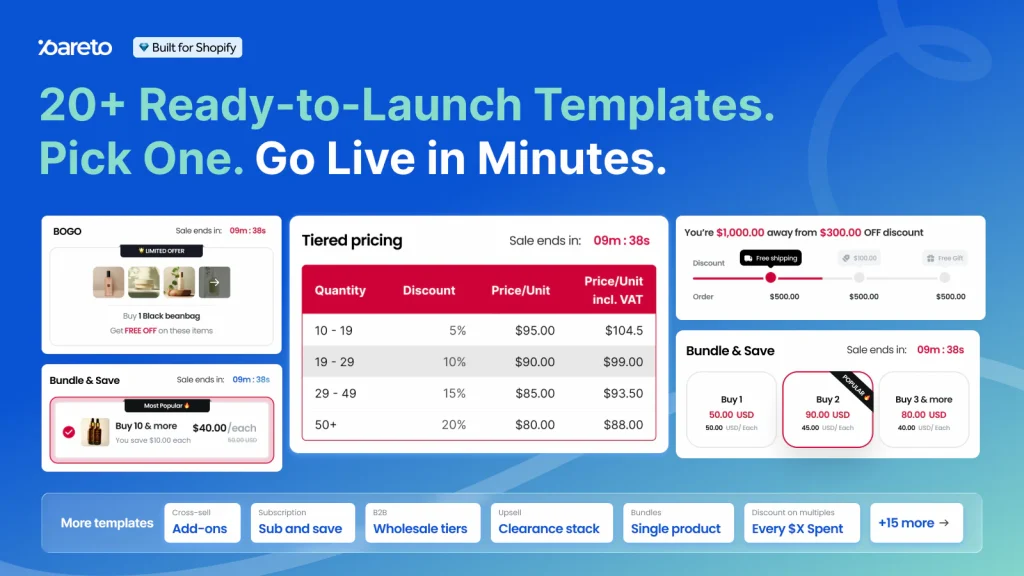
For example, to set up bundles without custom code, Shopify merchants can use Pareto Quantity Breaks & Discounts. The app supports Bundle, BOGO (Buy One, Get One), BXGY (Buy X, Get Y), and Volume Discount campaigns. You can pick products or whole collections, set the discount as a percentage, fixed amount, or specific price, choose who sees the offer (all shoppers, VIPs, or logged-in users), and schedule campaigns to run on their own during peak summer windows. The app works with all modern themes and needs no coding.
Volume discounts and quantity breaks
A quantity break is tiered pricing that rewards people for buying more. Think “Buy 2, get 10% off” or “Buy 5+, save 20%.” It works especially well in summer, when shoppers are already stocking up for trips, events, and gifts.
Quantity breaks usually run two ways:
- Volume bracket pricing: a set price for each quantity range. Hats might cost $5 each for 1 to 9 units, then drop to $3 each for 10 to 20.
- Tiered pricing: customers move up through discount levels as they add more, unlocking bigger savings at each step.
A summer quantity break might look like this:
- Buy 1 to 2 → standard price
- Buy 3 to 4 → 10% off
- Buy 5 to 9 → 15% off
- Buy 10+ → 20% off
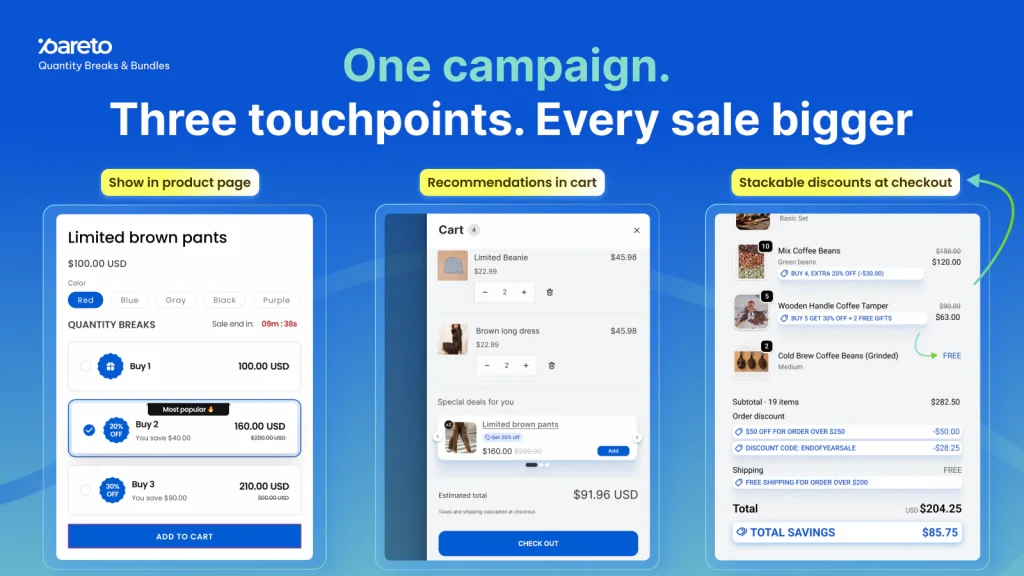
Our same app from the bundle section, Quantity Breaks & Discounts by Pareto, makes this easy. You can apply volume discounts to single variants, full products, whole collections, or your entire store. You can also target customer segments with customer tags, so B2B buyers see wholesale pricing while retail shoppers see standard tiers. The app supports pre-selected tiers, “Most Popular” badges to highlight your preferred option, and a toggle that shows standard and tiered pricing side by side for easy comparison. Discounts apply automatically in the cart, and many merchants recommend it for setting up B2B, bulk, and volume pricing.
Flash sales and urgency-based campaigns
A flash sale is a short, high-discount event built to drive a burst of orders in a tight window. Summer suits flash sales well, because the season already brings buyer energy, and a sharp deadline turns that energy into action.
The numbers back this up:
- Scarcity marketing can lift conversion rates by up to 30%.
- Flash sale emails with the discount in the subject line convert at just over 18%, versus about 3.8% for emails without. That’s almost five times better.
- The best flash sale length is 2 to 3 hours for impulse buys like beauty and accessories, which see open rates 59% higher than longer events.
- Fashion and electronics do better with 6 to 12 hour windows, since people take longer to decide.
- The discount sweet spot is 30% to 50%. Under 20% rarely creates urgency, and over 70% can make products look cheap.
Some summer flash sale ideas:
- Heatwave flash sale: trigger a discount or free shipping when local temperatures cross a set point.
- Weekend-only deals: run a recurring Friday-to-Sunday promotion all summer.
- Countdown timer offers: add visible countdown clocks to product pages, the cart, and your emails.
- “First 100 orders get 30% off”: mix limited quantity with a time limit for extra push.
Free shipping thresholds
Free shipping is one of the strongest conversion levers you have. Research shows 80% of shoppers will hit a minimum order amount to earn free shipping, though only about 58% actually add items to qualify. The trick is to set your threshold 10% to 30% above your current AOV. That way, customers add one more item instead of paying for delivery.
In summer, lowering that threshold for a while, or adding free shipping where you didn’t offer it before, is a cheap way to lift both conversion and AOV at the same time.
Loyalty program boosters
Summer is a great time to fire up your loyalty program, since customers are already in a generous, gift-giving mood. Tactics that work:
- Double points days on summer purchases or seasonal categories.
- Seasonal rewards, like branded sunglasses or tote bags for hitting spending milestones.
- Early access, giving members first pick of summer collections before the public.
- Leaderboard challenges that reward the season’s top spenders with tiered perks.
Loyalty matters even more in a cautious market, because price-sensitive shoppers gravitate toward brands that reward them. Trax Retail’s survey ranks loyalty programs among the most effective retention tools when costs are rising.
How to choose the right summer promotion for your shop
With so many options, the hard part is picking what fits your store. Use these quick rules to decide:
- If your goal is more first-time buyers, lead with seasonal discounts tied to a holiday. They give cautious shoppers an easy reason to try you.
- If your goal is a higher average order value, run bundles, quantity breaks, or a free-shipping threshold. Each one rewards customers for adding more to the cart.
- If your goal is a fast revenue spike, use a flash sale with a real deadline and a 30% to 50% discount.
- If your goal is repeat customers, invest in loyalty perks and early access for members.
You don’t have to choose only one. A strong summer plan often stacks them. For example, you can run a Father’s Day bundle, layer a free-shipping threshold on top, and reserve early access for loyalty members. The goal is to match the tactic to the result you want, not to discount for the sake of it.
Protect your inventory and margins
Running promotions at scale brings two risks: selling out too fast, and giving discounts to people who would have paid full price. Both are manageable with the right order controls.
When you run a flash sale or limited offer, you want to make sure:
- One customer can’t buy 50 units at a deep discount and wipe out your stock.
- High-demand products don’t oversell past what you actually have.
- Your “limited” claim is real and enforceable.
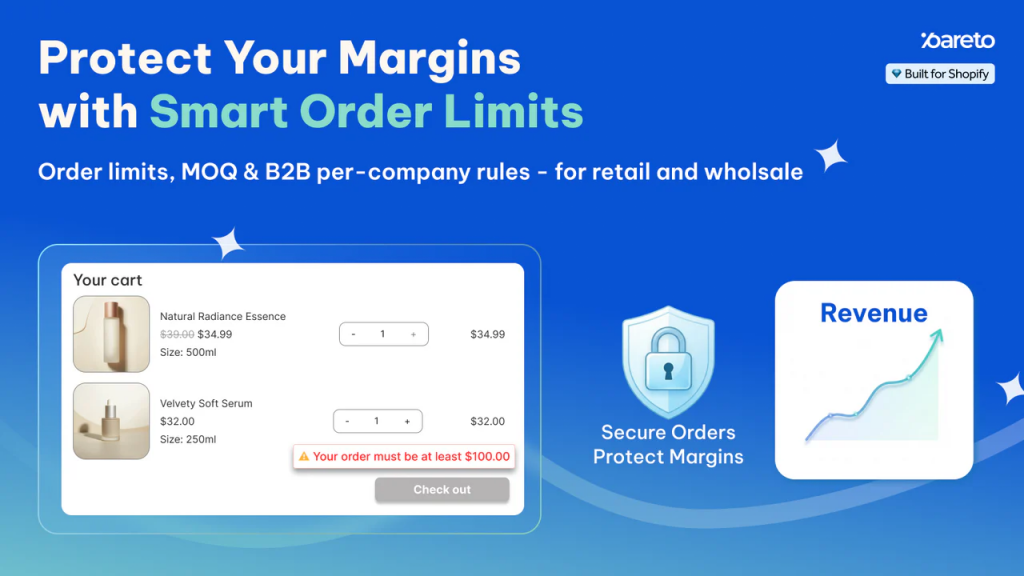
Pareto – Order Limits Quantity handles exactly this. It lets Shopify merchants set minimum order quantities (MOQ), maximum purchase limits, and checkout rules that protect inventory during busy events, with no coding required.
| Feature | Summer Use Case |
| Min/max quantity limits | Stop bulk buying on flash sale SKUs, or require a minimum for wholesale pricing |
| Flash sale and daily order caps | Cap how many units of a product sell per day during a summer event |
| Lifetime order limits | Stop repeat buyers from gaming per-order discount limits across many purchases |
| Scheduled rule activation | Turn limits on when a flash sale starts and off when it ends, automatically |
| Low stock counter | Show real inventory levels to create honest scarcity, not fake urgency |
| Strict checkout validation | Block oversized orders even through express payments like Shop Pay |
| Market and country targeting | Set different limits by region for global summer campaigns |
| Auto-translate messages | Limit messages translate to the customer’s language on their own |
The app has a free plan, plus paid tiers at $8.99/month (Basic), $19.99/month (Advanced), and $29.99/month (Shopify Plus only).
For limited drops, daylong flash events, or heavily discounted bundles, order limits keep your promotions profitable and your scarcity honest.
Summer is won in the planning
The merchants who win the summer don’t improvise. They use the data to build summer promotion ideas campaigns that feel timely and urgent. The plan is clear. Anchor your deals to real cultural moments. Build bundles around the experiences your customers already have in mind. Use quantity breaks to lift AOV without hurting margin. And protect your stock during big events with smart order limits. Tools like Pareto Quantity Breaks & Discounts and Pareto Order Limits give Shopify merchants the setup to run all of this automatically, without a developer.
Summer doesn’t wait. The shops that plan now are the ones collecting revenue when the season arrives.