
June 2026 recap: Pareto Quantity Breaks Lifted Merchant AOV by 34.26%!
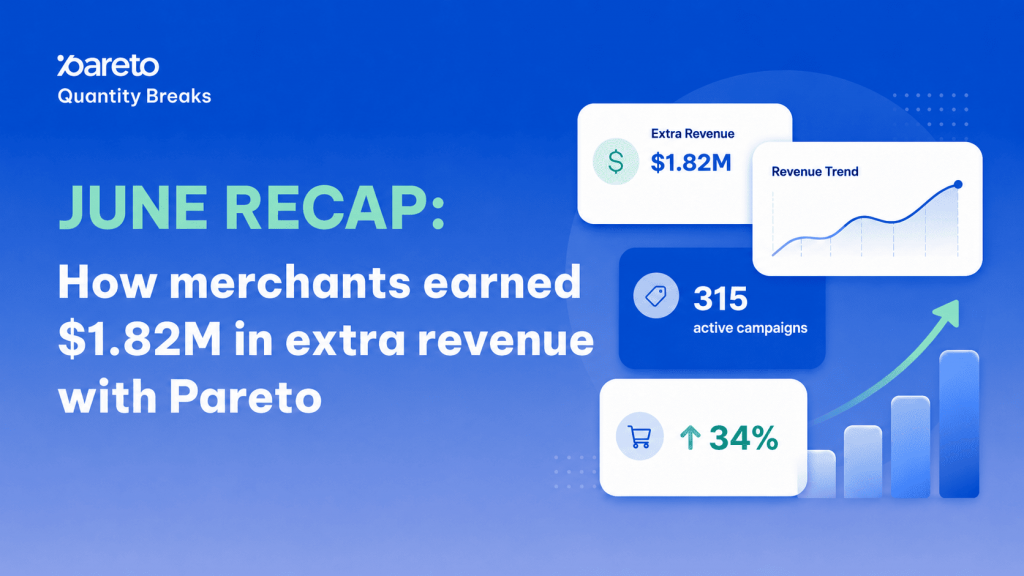
June was an absolute powerhouse of a month for merchants running volume discounts. If you’ve been looking for proof that strategic discounting actually drives higher order values rather than cutting into your margins, the data is officially in.
Pareto Quantity Breaks merchants crushed their growth goals by focusing on one key metric: Average Order Value (AOV).
Across all active stores, orders utilizing a Pareto discount achieved an AOV that was 34.26% higher than orders without one!
The 2026 June Power Numbers at a Glance
Together, the Pareto merchant community achieved some incredible milestones over the last 30 days:
These aren’t vanity metrics – they represent real dollars added to real stores. The $1,823,717.32 in extra revenue is money that existing customers spent on top of what they originally intended to buy, unlocked simply by presenting the right volume offer at the right moment. No extra ad spend, no new traffic, no discounting your way to a loss: just a bigger basket from shoppers who were already checking out.
Spread across 315 active campaigns and 17,523 orders, that works out to roughly $104 in additional revenue per order on average – a meaningful lift when you multiply it across a full month of traffic. And because quantity breaks reward customers for buying more rather than eroding your base price, most of that upside flows straight through to the bottom line instead of being eaten by blanket sitewide discounts.
The takeaway from the headline numbers is simple: the merchants who won in June 2026 didn’t get there by acquiring more shoppers. They got there by earning more from the shoppers they already had – the single most cost-efficient lever available to any store in 2026.
The Data Breakdown: What Contributed to Stronger AOV?
A 34.26% average lift is a headline worth celebrating – but averages hide as much as they reveal. Some stores in our ecosystem posted lifts well into the double digits, while others barely moved the needle, even though they were running the exact same Pareto quantity breaks. So we dug deep into our ecosystem data to figure out exactly why some stores saw massive success while others had modest gains.
The difference almost never came down to the discount itself. Stores with strong results and stores with weak results were often offering nearly identical tiers and savings. What separated them was where and how they showed those offers to shoppers – how early in the journey the savings became visible, and how clearly the value was communicated. Two undeniable patterns emerged, and both are things you can change in an afternoon:
1 Transparency Wins (Show the Discounted Price)
That is a more than five-fold difference from a single design choice. When shoppers can see the actual discounted price – “Buy 3, pay $45 instead of $60” – the math does the persuading for you.
They know exactly what they save and exactly what they get, so adding another unit feels obvious rather than risky. When the savings are buried behind a “discount applied at checkout” promise, shoppers have to take it on faith, and most simply don’t bother. Concrete numbers convert; vague promises don’t.
2 Catch Them Early (Collection Page Widgets)
Making savings visible earlier in the buyer journey helps shoppers understand the financial value of buying more before they ever reach the checkout page.
Put the two patterns together and the picture is clear: the biggest AOV gains didn’t come from deeper discounts – they came from better visibility.
Show the real, discounted price rather than a vague promise, and show it as early as the collection page rather than saving it for checkout. Neither change touches your margins or your product catalog; both simply give shoppers the information they need to say yes to a bigger order. If your store is currently sitting closer to the 5% contrast numbers than the double-digit proof numbers, these two fixes are almost certainly where your fastest wins are hiding.
3 High-Converting Tactics Our Successful Merchants Tried in June 2026
The top-performing stores in June succeeded because they made it incredibly easy for shoppers to add “just one more item” to their carts before, during, or after checkout.
If you want to replicate their success this month, test these three features of Pareto Quantity Breaks in your Shopify admin:
1. Shipping Discounts
Encourage shoppers to add another unit or product to their cart to unlock free or discounted shipping tiers.
- Set your free-shipping threshold roughly 10–20% above your current AOV so it’s a genuine stretch goal – high enough to lift orders, low enough that shoppers believe they can reach it.
- Show a live progress bar in both the cart drawer and mini-cart (“You’re $12 away from free shipping”) so the goal stays visible on every page.
- Pair it with a quantity break so the easiest path to free shipping is adding one more of what they already want – not a random filler item.
Carrier rates keep climbing in 2026, so free shipping stays the single biggest cart motivator – but protect margin by gating it behind a threshold instead of offering it site-wide. For Black Friday through December, temporarily lower the threshold to convert gift-buyers who are already spending more per order.
2. In-Cart Recommendations
Suggest the perfect complementary product directly inside the cart drawer. This helps customers seamlessly hit the next discount tier without interrupting their checkout flow.
- Recommend true complements – the accessory, refill, or bundle partner – not just more of the same product they already added.
- Trigger the suggestion when a cart is one item short of the next tier, and frame it around the reward: “Add 1 more to unlock 12% off.”
- Cap it at 2–3 recommendations so the drawer stays fast and uncluttered – a noisy cart kills conversion more often than it helps.
Let Pareto’s smart tier data auto-surface the product most likely to push each cart over its next break. In the quieter summer months (Jul–Aug), use in-cart recs to move slow-selling overstock; heading into Q4, switch the priority to high-margin add-ons and gift-wrap.
3. Post-Purchase Upsells
Present a hyper-relevant, one-click offer immediately after payment is completed – when the shopper’s buying intent and trust are at an all-time high.
- Because payment is already done, the offer adds revenue with zero checkout friction and no risk to your conversion rate – one click, no re-entering card details.
- Keep the offer hyper-relevant: a matching accessory, a bigger size, or a subscription of the exact item they just bought.
- Add a gentle time limit (“This one-time price expires when you leave this page”) so the deal feels exclusive without feeling pushy.
With acquisition costs staying high in 2026, use post-purchase upsells to introduce subscriptions and replenishment – one of the strongest retention levers you have. During Black Friday and the holidays, test an “add a second one at the same discount” upsell to capture gift-buying intent.
Your AOV playbook for the rest of 2026
Jul – Aug: Summer Lull
Experiment while traffic is calm. A/B test your free-shipping threshold, clear overstock through in-cart recommendations, and lock in the quantity-break tiers that hit the sweet spot before the busy season.
Sep – Oct: Pre-Holiday
Turn on visibility everywhere. Add tier offers to your collection pages (June’s data showed a 14.6% lift), warm up your gift bundles, and make sure discounted prices are shown up front — not hidden until checkout.
Nov: BFCM Peak
Stack your offers. Lower the free-shipping threshold, run your deepest quantity breaks, and put an aggressive post-purchase upsell on every order while buying intent is at its highest point of the year.
Dec: Holiday Finish
Sell the gift, not just the product. Lead with gift bundles and gift-wrap upsells, add shipping-deadline urgency, and keep the “add one more” messaging front and center for last-minute shoppers.
💥 Ready to Blow Up Your AOV?
Every e-commerce store has a unique audience, but the data proves that small tweaks to your offer visibility can yield massive revenue differences.
You don’t have to change your entire strategy overnight – just start with the single tactic above that best aligns with your current store design and monitor the lift.
Need help choosing or setting up your next campaign? We’ve got your back. Drop us a line by email us or launch a live chat from your Pareto dashboard. Let’s make next month even bigger!
👉 Launch a campaign with Pareto
Put June’s playbook to work in your own store. Launch your first quantity-break campaign – with savings shown up front, right from the collection page – in just a few minutes.
Try Pareto