
Christmas Discount Ideas: What Should Do in This 2026
Christmas shoppers buy at different times. Some start in October. Others wait for Cyber Week or finish their shopping just before Christmas. Many return after December 25 to use their gift cards. Because of this, one sitewide discount is rarely enough. It gives every customer the same offer, does not encourage larger orders, and may reduce profit on purchases that would have happened anyway.
A better plan is to adjust your offers as shopping habits change throughout the season. The Christmas discount ideas below use the latest full-year data from 2025 to help you plan for 2026. You will also find a campaign calendar, real brand examples, and Shopify tools that can reduce manual work.
What is Christmas marketing?
Christmas marketing is the set of campaigns a retailer uses to help customers discover, choose, buy, and receive holiday products. It can include discounts, gift bundles, free gifts, loyalty offers, gift guides, email, SMS, social content, paid ads, in-store displays, pickup, and post-Christmas sales.
The audience is wider than people buying presents. It includes customers shopping for parties, decorations, food, self-gifts, and other end-of-year needs. Campaigns can run online, in an app, in a physical store, or across all three.
Christmas also differs from a normal promotion. Shoppers often need several products for several people, all before a fixed deadline.
Price matters, but so do gift guidance, delivery confidence, and a fast option for late purchases. The strongest Christmas promotion ideas lower the effort of gift shopping, not just the price.
For merchants, a well-built campaign can raise units per order, move seasonal inventory, bring back past buyers, and turn new holiday shoppers into repeat customers.
Why Christmas is a retail goldmine by the numbers
The 2025 season showed strong demand, but it also showed why timing and offer design matter.
- U.S. consumers spent a record $257.8 billion online from November 1 through December 31, up 6.8% year over year, according to Adobe’s 2025 Holiday Shopping Report.
- The National Retail Federation’s 2025 holiday survey found that shoppers planned to spend $890.49 per person on gifts and other seasonal items. Gifts for family and friends accounted for $627.93 of that budget.
- The same NRF survey found that 42% planned to begin shopping before November, 60% expected to finish in December, and online was the top shopping destination at 55%. Christmas promotion ideas for retail therefore need to cover both early and late demand across digital and physical touchpoints.
- Adobe also found that mobile generated 56.4% of online holiday revenue, while traffic from large language model sources rose 693.4% year over year. Keep offers easy to use on a phone and simple enough for shoppers or AI tools to compare.
Shopify merchants generated $14.6 billion in global BFCM sales, up 27% from 2024, with an average cart price of $114.70. The data covers Shopify’s ecosystem rather than the whole retail market, but it shows how buying intent concentrates around a few promotional days.
The season did not end with Cyber Monday. After Thanksgiving weekend, shoppers still had 53% of their holiday shopping left. Later, 70% planned to shop during the week after December 25, mainly to use promotions or spend gift cards.
Strategic takeaway: plan for several buying moments, not one Christmas sale. Give early shoppers confidence, peak shoppers a clear reason to act, late shoppers convenience, and post-Christmas shoppers a relevant next offer.
The 2026 Christmas marketing calendar: Why timing matters
For U.S. merchants, Thanksgiving falls on November 26, 2026, Black Friday on November 27, and Cyber Monday on November 30. Those dates create a clear peak, but research and buying begin much earlier.
| Period | What customers are doing | What merchants should do |
|---|---|---|
| Preparation: August–September | Low purchase intent; researching ideas and building wish lists | Check margins and stock, choose hero products, build gift guides, plan SEO, prepare creative, and test offer rules |
| Early stage: October–November 25 | Browsing, comparing, and spreading purchases across paychecks | Launch gift discovery, loyalty early access, small targeted offers, bundles, and email-list growth |
| Peak: November 26–30 | High buying intent and active price comparison | Run the main promotion, keep terms simple, retarget high-intent visitors, and monitor stock and checkout performance |
| Late and follow-up: December 1–January 3 | Completing lists, checking delivery dates, buying gift cards, then shopping post-Christmas sales | Promote last-call offers and pickup, switch to digital gifts near the deadline, then run gift-card and inventory-led follow-up campaigns |
The message should change with each stage: an October campaign can focus on planning with “Build your gift box and save 10%.” Cyber Week needs a stronger reason to act. In the final week, lead with availability, pickup, delivery cutoffs, or digital gift cards instead of making an unsafe shipping promise.
Avoid running the exact same 20% discount from October through December. A long, unchanged sale loses urgency and teaches shoppers that the stated deadline does not matter. Keep the campaign theme consistent, but change the offer, audience, or product focus as intent rises.
4 plays from brands winning the holiday season
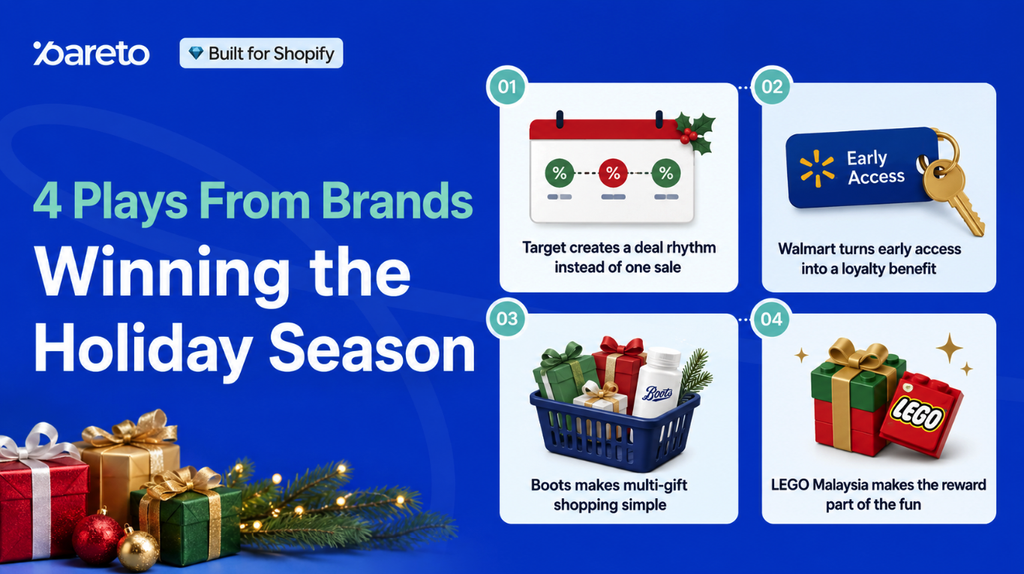
These brands operate at a larger scale than most merchants, but the mechanics behind their promotions are easy to adapt.
Play #1: Target creates a deal rhythm instead of one sale
What the brand did: Target’s 2025 holiday plan introduced daily and weekly deals, ran a Deal of the Day through December 24, and offered a holiday price-match guarantee from November 1 through December 24. It also merchandised thousands of gifts starting at $5, according to Target’s holiday shopping fact sheet.
Why it worked: Changing offers gave customers a reason to return, while the price guarantee reduced the risk of buying too soon. Budget gift sections made the catalog easier to shop.
How merchants can apply it: Run a weekly category deal or 12-day countdown and add “under $25” and “under $50” gift collections. If a price guarantee is not practical, reassure early buyers with loyalty points, a small gift, or first access to limited stock.
Play #2: Walmart turns early access into a loyalty benefit
What the brand did: Walmart opened its October 7–12, 2025 holiday event to everyone, with savings of up to 50% across major categories. Walmart+ members received a five-hour head start, according to the retailer’s holiday event announcement.
Why it worked: The sale reached a broad audience, while early access rewarded members without requiring a larger discount. The limited window also created urgency before November.
How merchants can apply it: Let subscribers, loyalty members, or past customers enter a Christmas sale several hours early. Promote access, not just price. The tactic suits limited stock, product drops, or bundles likely to sell out.
Play #3: Boots makes multi-gift shopping simple
What the brand did: Boots uses a 3-for-2 mix-and-match Christmas offer across selected gifts rather than requiring shoppers to buy three identical products.
Why it worked: Christmas buyers often need gifts for several people. A cross-category rule helps them complete more of the list in one order, while the free lowest-priced item keeps the saving easy to understand.
How merchants can apply it: Create a “Pick any three gifts” collection and keep eligible products within a sensible price range. Group them under the same shelf sign in-store; online, show the rule on collection pages, product pages, and in the cart.
Play #4: LEGO Malaysia makes the reward part of the fun
What the brand did: From December 13–24, 2025, LEGO Malaysia gave shoppers who spent at least MYR289 one chance to pick a prize box. The official promotion terms made the reward subject to stock and limited it to one per customer and receipt.
Why it worked: The threshold encouraged a larger purchase without cutting the price of every set. The surprise element also made the reward more memorable than a standard coupon.
How merchants can apply it: Offer a mystery gift, rotating daily gift, or “choose one of three” rewards above a cart threshold. State the qualifying spend, end date, stock limit, and redemption cap. Surprise should make the campaign fun, not confusing.
Top Christmas discount ideas and marketing strategies for 2026
Start with the business goal. A discount should earn a larger basket, faster stock movement, a recovered cart, or a more valuable customer relationship. If it does none of those things, it is lost margin.
| Strategy | Impact | Effort | Key metric or reason |
|---|---|---|---|
| Tiered spend or quantity discounts | High | Low–medium | AOV, units per order, incremental gross profit |
| Gift bundles and mix-and-match sets | High | Medium | Bundle attach rate, AOV, sell-through |
| BOGO or gift with purchase | High | Medium | Redemption rate, units per order, margin after reward |
| Targeted discounts | High | Medium | Conversion and margin by customer segment |
| Flash sales or 12 Days of Christmas | Medium–high | High | Revenue per campaign, repeat visits, unsubscribe rate |
| Email, SMS, and cart recovery | High | Low–medium | Recovered revenue, revenue per recipient |
| Social, creators, and paid retargeting | Medium–high | Medium | CAC, ROAS, assisted conversions |
| Late-shopping and post-Christmas offers | Medium | Low | Pickup orders, gift-card sales, post-December 25 revenue |
#1 Use tiered spend or quantity discounts
A flat percentage can increase conversion, but it gives customers no reason to add another item. A tiered offer connects the saving to a larger order.
For example:
- Spend $75 and save 10%
- Spend $125 and save 15%
- Spend $175 and save 20%
For products customers naturally buy in multiples, use quantity breaks instead: buy two and save 10%; buy four and save 15%. Show the next tier in the cart so the shopper can see exactly what one more item unlocks.
Set each threshold slightly above a meaningful basket level. Check contribution margin at every tier, exclude low-margin products when needed, and measure gross profit as well as AOV. A higher order value is not a win if the discount removes the extra profit.
#2 Build gift bundles that remove choices
Holiday shoppers often know the recipient but not the exact product. A skincare routine, coffee starter kit, or “choose any three” bundle turns several products into one clear answer.
Offer a modest saving or gift-ready packaging. Use fixed bundles for speed and mix-and-match bundles when size, shade, taste, or dietary preference matters. Add labels such as “Gifts for coworkers under $30” or “For the home cook.”
Adobe’s 2025 popular products included skincare, luggage, and cookware sets. Products that belong together already feel gift-ready. Track bundle attach rate and whether the bundle moves slow stock without trapping a best seller in an unprofitable deal.
#3 Choose between BOGO and a gift with purchase
BOGO works best when the extra unit is useful, such as socks, candles, snacks, beauty items, or small gifts. “Buy two, get the third 50% off” can protect more margin than a free second item while still growing the basket.
A gift with purchase often suits premium products because it preserves the main price while adding value above a threshold. Use a sample, accessory, seasonal item, or low-cost product with high perceived value.
For either format, define which item receives the discount, whether customers can choose the reward, and how many times the offer applies. Show those terms before checkout to prevent disappointment and support tickets.
#4 Target the offer instead of discounting everyone
The same offer should not go to a loyal customer, a first-time visitor, a wholesale buyer, and a shopper who abandoned a high-value cart.
Give past customers early access or a smaller loyalty offer, while first-time shoppers see an entry bundle. Remind browse abandoners about the category they viewed. Reserve stronger discounts for customers who need more persuasion.
Klaviyo’s global 2025 holiday study found that customers preferred deals on products they had already viewed or saved. Start with a few reliable segments – new, returning, VIP, and high-intent abandoners – before adding more rules.
#5 Run a sequence of short offers
A flash sale works because the deadline is believable. It can focus attention on one category, clear a specific stock pocket, or bring customers back during a quieter day.
A “12 Days of Christmas” series gives the format a seasonal reason to exist. Rotate the mechanic: a bundle on day one, free gift on day two, loyalty bonus on day three, and category offer on day four.
Publish the calendar internally before launch. Confirm inventory, margin, creative, channels, dates, and ownership. Twelve repetitive emails in twelve days will create fatigue faster than sales.
#6 Connect email, SMS, and cart recovery
Email can explain a gift guide or bundle. SMS suits a short early-access alert or final deadline. Cart and browse recovery bring shoppers back to products already under consideration.
Klaviyo’s BFCM 2025 results attributed 42% of GMV in its ecosystem to email and text. Discounts fell from an average 29.1% to 26.2%, while repeat-buyer revenue grew faster than new-buyer revenue. Use owned channels and customer context before reaching for a deeper public discount.
Build a simple flow: reminder, gift guidance or proof, then a deadline. Stop when the customer buys. On mobile, put the offer near the top and link directly to the relevant collection or cart.
#7 Use social, creators, and paid ads to demonstrate the offer
Social content should show what the customer gets, not repeat “20% off” on a festive background. Ask creators to build a gift box, compare bundle options, or show gifts at different budgets. Reuse that content on product pages and in retargeting ads.
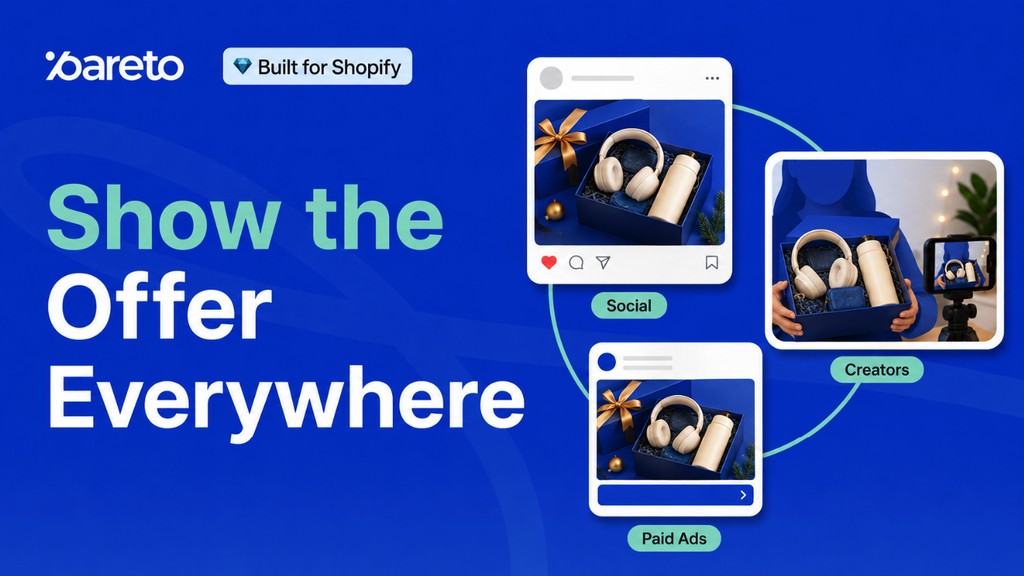
Separate prospecting from retargeting. New audiences need a clear product reason and gift use case. Past visitors may respond to the offer, stock status, reviews, or deadline. Keep the terms consistent from ad to cart.
Track customer acquisition cost and contribution margin, not only return on ad spend. When media, fulfillment, and discount costs rise together, a strong revenue number can hide a weak order.
#8 Plan for late shoppers and the week after Christmas
As shipping deadlines pass, switch the promise. Promote store pickup, local delivery, digital gift cards, printable gift notes, or experience-based products. Salesforce’s 2025 holiday data found that buy online, pick up in store reached one in three online orders during the final five days before Christmas.
After December 25, speak to a different need. Run a gift-card bonus, a “complete the set” cross-sell, or a controlled clearance for customers with gift cards, returns, or holiday cash. Stop calling it a last-minute Christmas sale once Christmas has passed.
For physical retail, connect the channels. Show local pickup in email, place QR codes beside gift displays, and train staff on the same offer and return rules. Customers should get the same answer online, in the cart, and at the counter.
Use upsells to help last-minute shoppers finish their gifts. In the cart, recommend add-ons available through the same pickup or delivery option, such as batteries for a toy. Right after payment, a post-purchase offer can give shoppers a chance to add gift wrap. On the thank-you page, keep pickup instructions easy to find and place any recommendations below the order details. After Christmas, use the order tracking page to suggest something customers can use with their gift, such as filters for a new coffee maker. AI-powered recommendations can help match add-ons to what shoppers have in their cart or what they’ve already bought.
How to run the campaign without adding manual work?
A strong Christmas plan can still fail if each offer needs a separate app, spreadsheet, code change, and midnight launch. The promotion should become easier to control as demand rises.
Increase order value with one promotion system
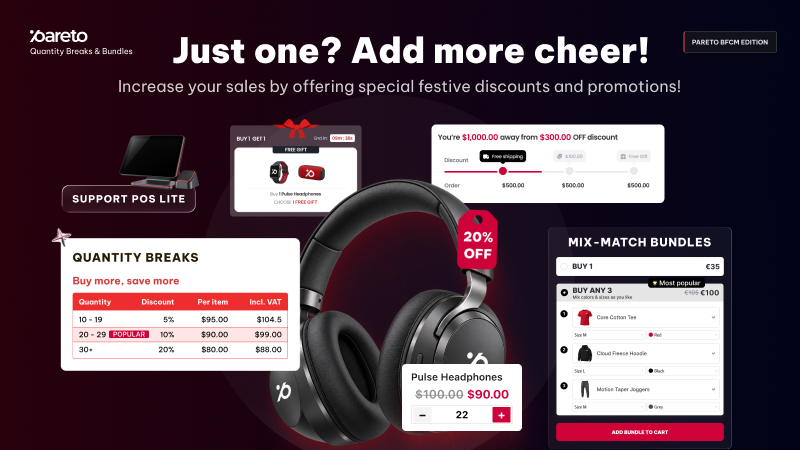
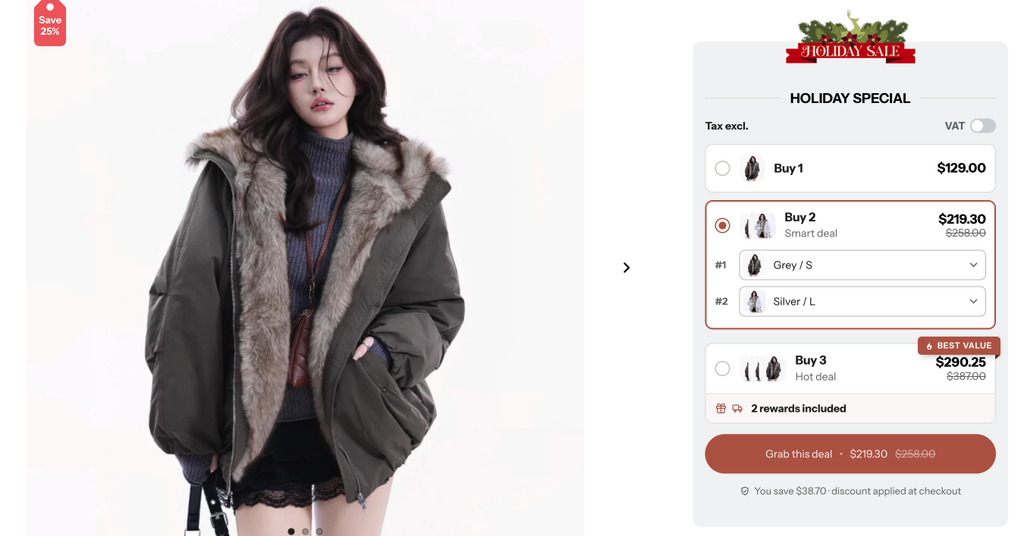
Pareto Bundles Quantity Break supports quantity breaks, tiered pricing, bundles, BOGO, free gifts, cart discounts, and upsells. It covers most offers in this guide without a separate workflow for each one.
Place each offer where customers make the decision – on product and collection pages, in the cart, and on supported checkout surfaces. A clear “add one more item to unlock 15% off” message does more work than a discount that appears without explanation.
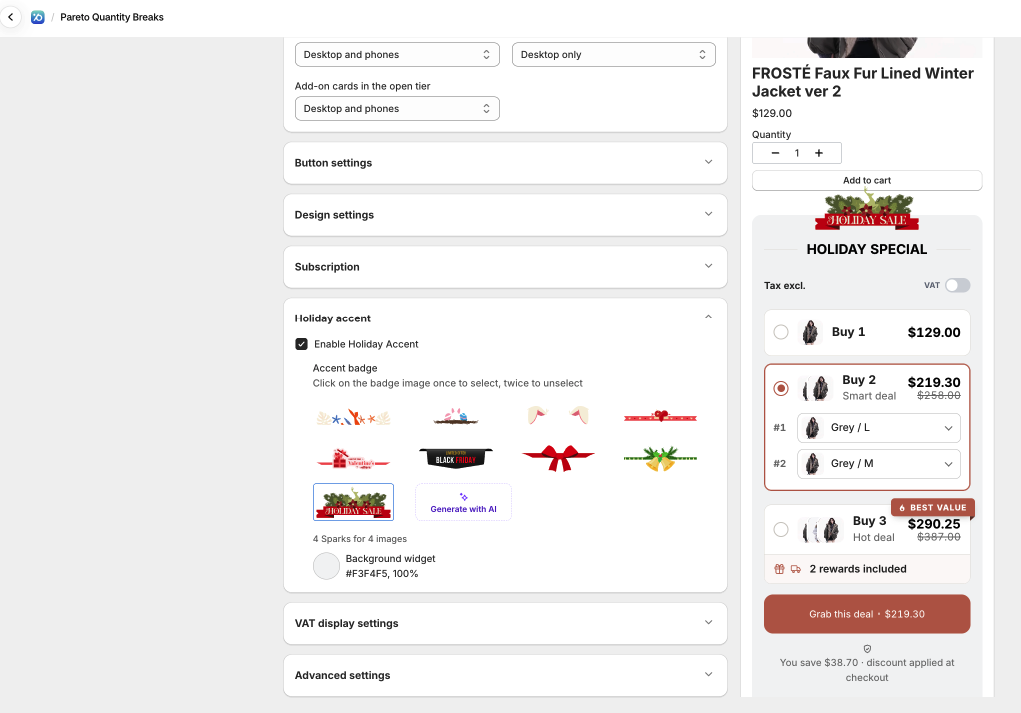
Track conversion rate, AOV, units per order, and extra revenue. Also calculate discount efficiency: extra revenue attributed to the promotion divided by discount cost. If every $1 of discount creates little extra revenue, the offer may be subsidizing existing orders rather than creating valuable growth.
Make setup and migration easier
Pareto’s current Shopify App Store listing includes campaign scheduling, CSV import and export, migration between stores, Shopify Flow automation, and faster campaign creation with AI agents. This matters when a merchant has many products, markets, or storefronts.
Prepare rules in advance, import them in bulk where practical, and schedule the start and end times. Use one naming system, such as XMAS26_EARLY_VIP_BUNDLE, so the team can find offers quickly. Once the campaign is live, use Pareto’s AI Insights to track how your offers perform and get suggestions on what to adjust. For example, if shoppers place orders but rarely qualify for a free gift, check how far their cart totals fall below the minimum spend. If many are just short, A/B test a lower threshold against the original. Compare average order value and profit per order to see whether the change pays off.
Test the full path on mobile and desktop: product page, variant selection, cart, discount calculation, checkout, confirmation, cancellation, and refund. Automation removes clicks; it does not remove the need for a final check.
Protect margins and inventory
Growth offers need guardrails. Pareto Order Limits can set minimum and maximum quantities, lifetime or IP-based limits, customer-tag and market rules, B2B limits, and checkout validation through Shopify Functions.
Use maximum limits for scarce gifts, limited editions, and free items. Apply minimums only when pack size or fulfillment economics justify them. Exclude weak-margin products, cap gift redemptions, prevent unwanted stacking, and stop an offer when promotional stock runs out.
Before launch, record product margin, maximum discount cost, promotional stock, expected order volume, and minimum contribution per order. During the campaign, watch revenue, margin, stock, conversion, AOV, and discount efficiency together. A high-revenue promotion can still be an expensive giveaway.
Final Words
Build the campaign in layers: create demand early, run a clear peak offer around Cyber Week, and keep bundles, targeted discounts, and last-minute options ready for December. Protect each layer with margin floors, stock limits, simple terms, and tested checkout rules. Pareto brings growth and control together. Use Pareto Quantity Breaks to encourage larger baskets and Pareto Order Limits to prevent the wrong orders from consuming margin or inventory. Prepare and schedule these Christmas discount ideas before traffic rises, then make every discount earn its place.