
Tiered Pricing vs Volume Pricing: When To Use?
Running a store means constantly thinking about pricing. You want customers to buy more, but you also need to keep your profits healthy. That’s where tiered pricing vs volume pricing comes into play. These two strategies might sound similar, but they work very differently. One charges different rates for different chunks of an order. The other gives everyone the same low price once they hit a certain number. Which one’s right for your store? Let’s break it down.
What Is Tiered Pricing?
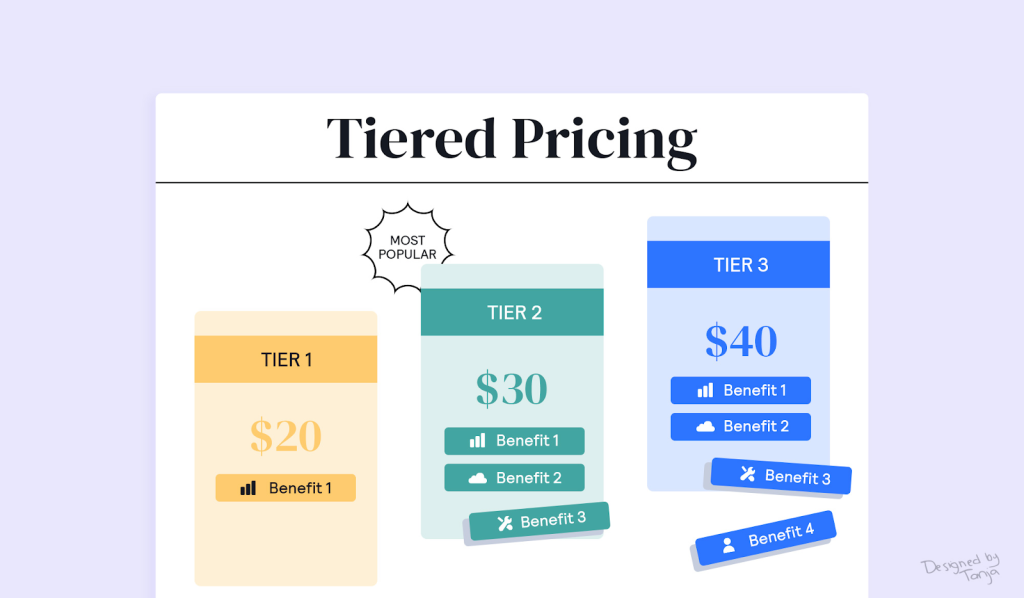
Think of tiered pricing like climbing stairs. Each step up gets you a better deal, but only for the items in that step.
Here’s how it works: Say you’re selling t-shirts. Your pricing might look like this:
- First 10 shirts: $15 each
- Next 10 shirts (11-20): $12 each
- Everything after 20: $10 each
If someone buys 25 shirts, they don’t get $10 each for everything. They pay $15 for the first 10, $12 for the next 10, and $10 for the last 5. The total comes out to $290.
Why do businesses use this? It’s pretty clever, actually. Small buyers still pay full price (keeping your margins happy), while big buyers get rewarded without you giving away the farm. It’s like saying, “Hey, we appreciate bigger orders, but we’re not going crazy with discounts.”
The tricky part? It’s not built into Shopify by default. You’ll need an app or some custom work to make it happen. But when done right, customers understand they’re getting a fair deal that scales with their purchase size.
What Is Volume Pricing?
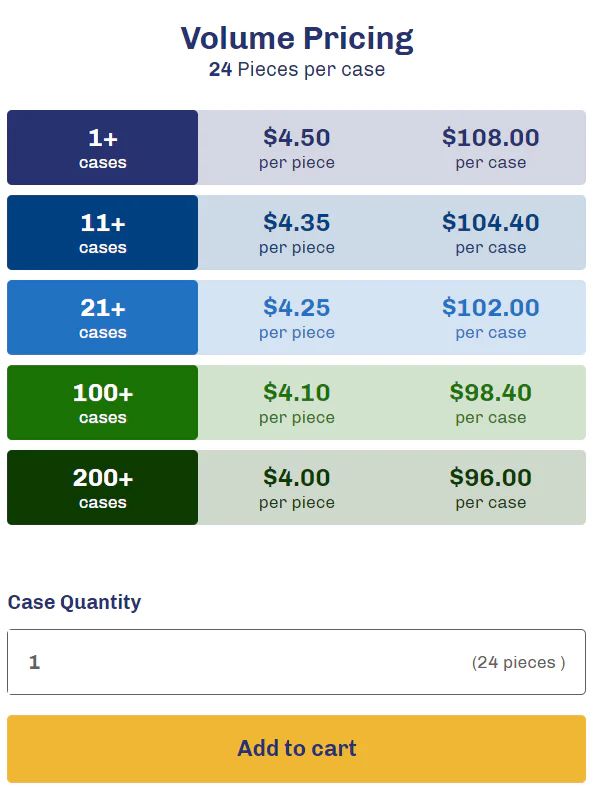
Volume pricing is much simpler. Hit a certain number, and boom – every single item in your cart gets the better price.
Using those same t-shirts:
- 1-10 shirts: $15 each
- 11-20 shirts: $12 each
- 21+ shirts: $10 each
Buy 25 shirts? Every single one costs $10. Total: $250. That’s $40 less than tiered pricing for the same order.
Volume pricing is what most people think of when they hear “bulk discount.” It’s straightforward, easy to understand, and makes customers feel like they’re getting a steal. The downside? You’re giving up more profit per sale.
This approach works great when you want to move lots of product fast or when you’re dealing with wholesale buyers who expect one consistent price for their entire order.
Tiered vs Volume Pricing: The Real Differences
Both strategies encourage customers to buy more, but they work in completely different ways. Think of it like this: tiered pricing is like climbing a staircase, where each step gets you a better deal on the next batch of items. Volume pricing is like an elevator – hit the right floor and suddenly everything in your cart gets cheaper.
The difference might seem small, but it has a huge impact on your profits, how customers perceive your deals, and even which types of buyers you attract. Let’s break down exactly how these two approaches stack up against each other.
| Aspect | Tiered Pricing | Volume Pricing |
|---|---|---|
| ✅ The Upside | • Higher profit per large order than volume pricing | • Super easy to understand – “Buy X, pay $Y for each” |
| • Small customers can still buy without discounts | • Motivates customers to increase quantity to get better deal | |
| • Customers are nudged to add more to reach next tier | • Works great for wholesale buyers who expect consistent pricing | |
| • Great for stores with mixed customer types (B2C + B2B) | • Easy to implement using Shopify’s built-in discount tools | |
| ❌ The Downside | • Can confuse customers with mixed per-unit pricing | • Lower profit margin on large orders |
| • Needs third-party app or custom setup on Shopify | • “Cliff effect” – just-missed discounts feel unfair to some buyers | |
| • Some customers may find savings too small or complex | • Can trigger stock issues if too many bulk orders come in at once | |
| • Large buyers may want a simpler, flat pricing model | • Less control over price discrimination between buyer types |
Let’s get into the nitty-gritty of how these two stack up:
Money Matters
With tiered pricing, you keep more revenue per large order because those first units still sell at higher prices. Volume pricing gives customers bigger savings but cuts deeper into your margins. It’s the classic trade-off between profit per sale and total sales volume.
Customer Psychology
Volume pricing creates excitement – customers feel like they’re getting an amazing deal once they qualify. Tiered pricing feels more gradual and fair, but some customers might not understand why they’re paying different prices for different parts of their order.
How Easy Is It?
Volume pricing wins here. Shopify’s built-in discount features can handle most volume discount scenarios. Tiered pricing usually needs a third-party app or custom coding to work properly.
Who Responds Best?
Volume pricing appeals to wholesale buyers and bargain hunters who want one simple price for everything. Tiered pricing works well when you’ve got a mix of small and large customers shopping in the same place.
Tiered vs Volume Pricing: How To Set Up In Just One App?
You don’t need multiple tools to offer both tiered pricing and volume pricing on your Shopify store. Pareto – Quantity Breaks & Discounts gives you everything in one app that’s built specifically for Shopify merchants who want to boost sales using different pricing strategies.
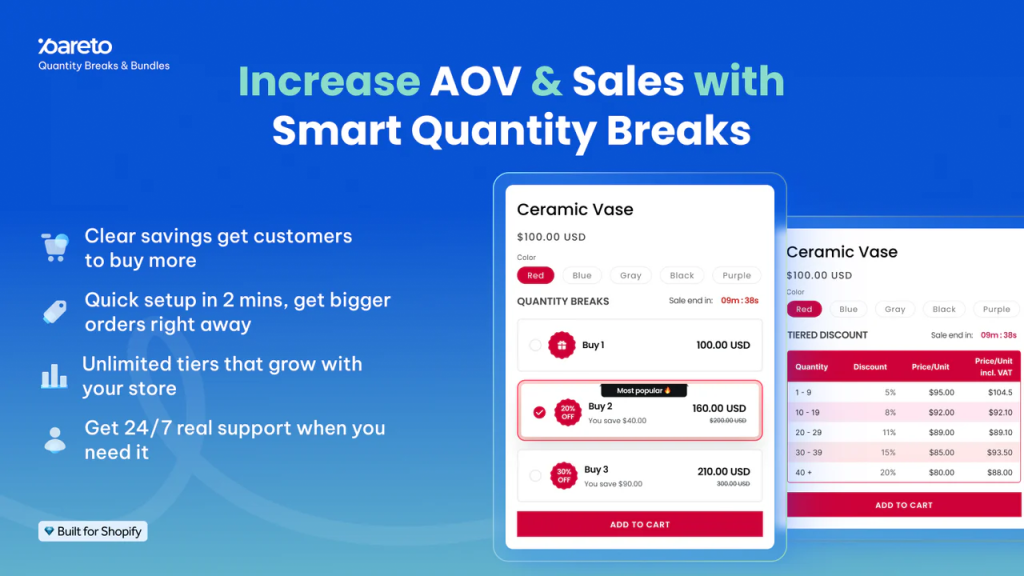
Whether you’re selling to regular customers who need a little nudge to buy more or wholesale buyers looking for bulk deals, Pareto handles it all.
Volume Pricing
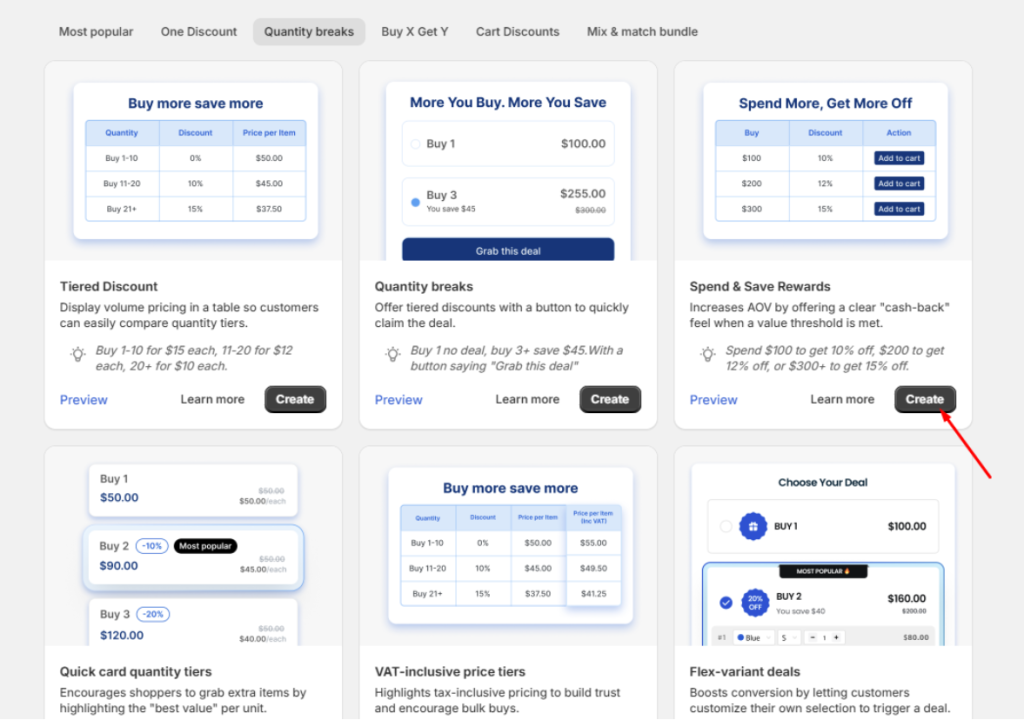
Setting up volume pricing with Pareto – Quantity Breaks & Discounts app is straightforward:
- Pick a product or an entire collection
- Create quantity-based discount rules (like “Buy 10 or more, get 10% off everything”)
- Show the discounts right on your product pages with the built-in discount widget
- Customers see their savings immediately – the discount applies to every item once they hit your threshold
Works great for: wholesale buyers, large orders, flash sales, and clearing inventory fast
Tiered Pricing
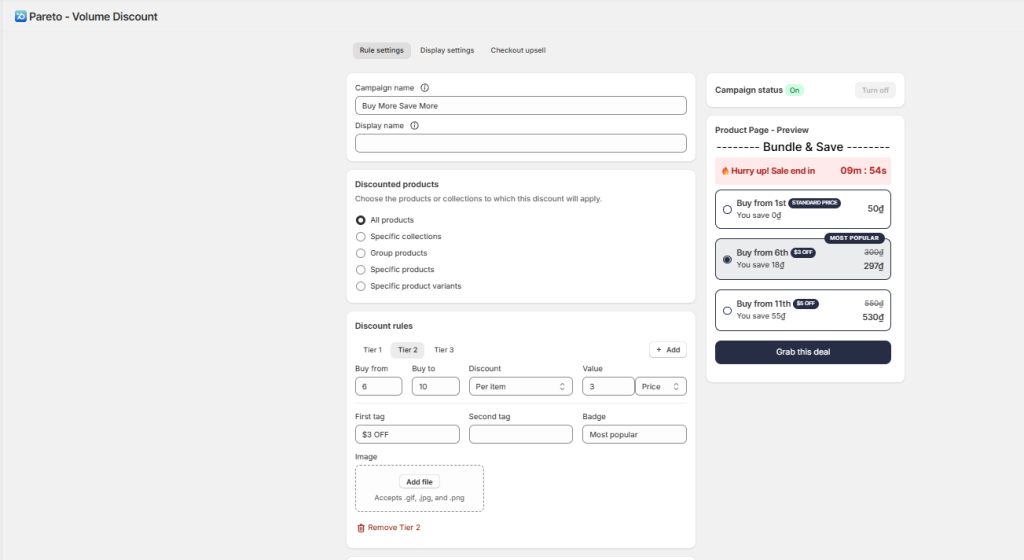
Pareto feature lets you get more sophisticated:
- Set different prices for different quantity ranges (like 1–9 units = $5 each, 10–19 = $4.50 each, 20+ = $4 each)
- Only the items in each tier get that tier’s price
- A clear pricing table shows customers exactly how prices change with quantity
- You can even target specific customer groups or offer special pricing for logged-in users
Perfect for: stores with both retail and wholesale customers, maximizing revenue per order
Pareto doesn’t stop at volume and tiered discounts. You also get:
- Product Bundles: Mix and match items with bundle savings
- Buy X Get Y deals: Set up “Buy 2, Get 1 Free” promotions easily
- Free gifts and shipping: Triggered when customers hit certain quantities or spend amounts
- Upsells and cross-sells: Boost sales on thank-you pages and in cart drawers
- Countdown timers: Create urgency during sales events
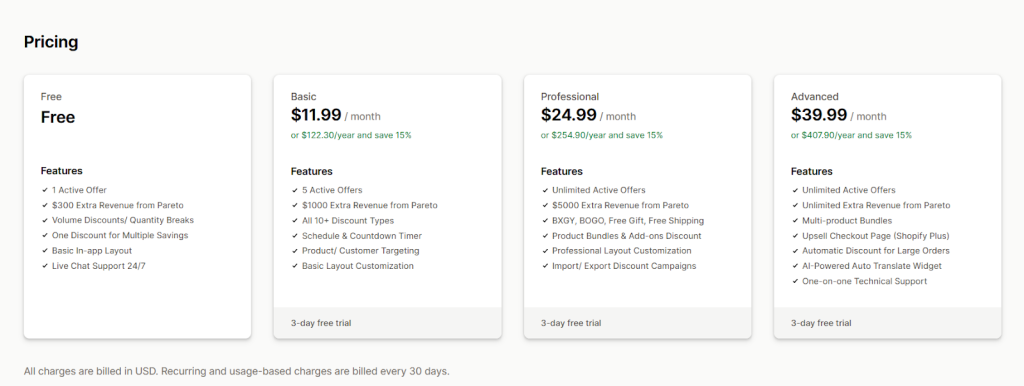
Pareto offers plans for every business size. Best, all plans come with a 3-day free trial and work seamlessly with modern Shopify themes and Online Store 2.0.
The key is matching your pricing strategy to how your customers actually shop. Simple volume discounts work great for straightforward bulk buying, while tiered pricing gives you more control over margins with diverse customer types.
Real Examples Of Tiered Pricing and Volume Pricing That Work
Better Packaging Co. – The Smart Way to Price for Everyone
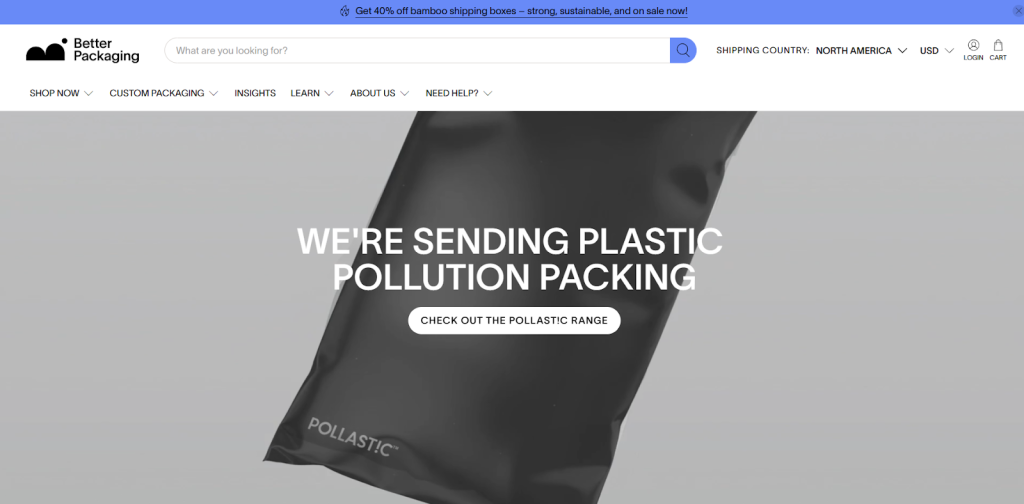
Better Packaging Co. sells eco-friendly mailers to a wildly diverse customer base. They’ve got Sarah, who runs a small jewelry business on Etsy and needs maybe 25 mailers a month. Then there’s a huge online retailer shipping 5,000 packages weekly.
The challenge? How do you price fairly for both without losing your shirt? Better Packaging Co. cracked this code with their clever tiered approach that rewards bigger orders without punishing smaller ones.
How They Made It Work: Instead of one-size-fits-all pricing, they created a system that scales with order size:
- Small orders (1-50 pieces): Regular price of 45 cents each
- Medium orders (51-500 pieces): Price drops to 38 cents each for those extra units
- Large orders (501-2,000 pieces): Goes down to 32 cents each for the highest quantity
- Huge orders (2,000+ pieces): They’ll work out a custom deal
Result: When someone orders 100 mailers, they pay 45 cents for the first 50, then 38 cents for the next 50. Average: about 41.5 cents per mailer.
This got customers buying 15-20% more. They’d think, “If I order 10 more, I’ll save money on those extras.” Small buyers stayed happy with fair pricing. Big buyers got real discounts without the company giving away everything.
Key Takeaway: Clear messaging on product pages like “Order 200 more and save $15” showed customers exactly what they’d gain. One pricing system served everyone without alienating any customer type.
Ocean Spray – When Simple Beats Complicated Every Time
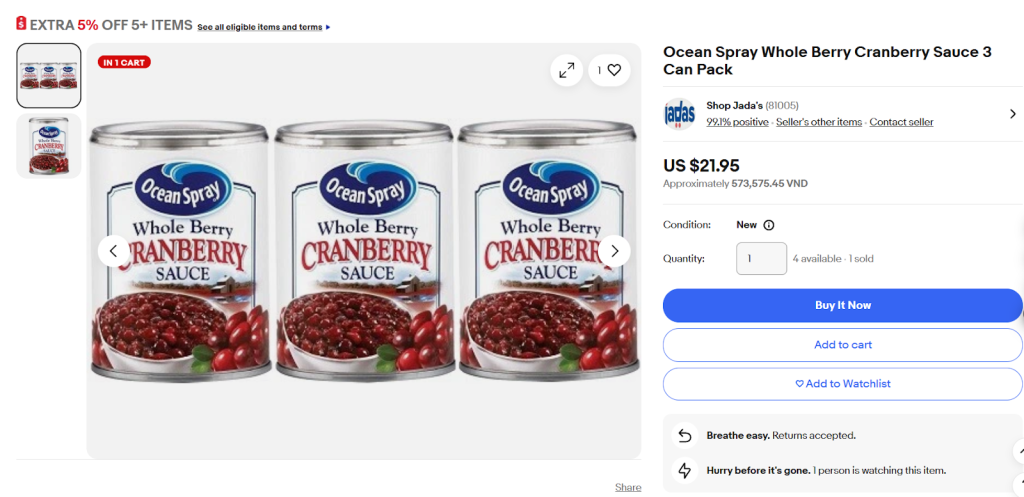
Overview: Ocean Spray faced a classic holiday challenge: getting customers to buy more cranberry sauce during their crucial Thanksgiving and Christmas season. Most people just grabbed one can, but families needed multiple cans for Thanksgiving and Christmas meals. Their solution was beautifully simple.
Their Brilliant Move: They made the math so simple a kid could figure it out:
- One can by itself: $2.84
- Three-pack: $4.26 total
That’s less than $1.50 per can when you buy the bundle. Basically, you’re getting the third can almost for free.
What Happened: Shoppers saw they could get three cans for less than the price of two individual ones ($4.26 vs $5.68). It was a no-brainer.
Results:
- 3-pack sales tripled compared to the previous year
- Overall, cranberry sauce sales nearly doubled during the holidays
- More customers switched from single cans to bundles
Why It Worked: Zero confusion. No complicated math. Customers instantly saw the value and felt silly for not taking the deal.
Bonus Effect: People bought 3-packs for holidays but had leftovers. Many tried new recipes and became year-round buyers.
The Lesson: Simple, obvious value wins. When customers understand the deal immediately, they buy without hesitation.
Flash Furniture – How Volume Pricing Opened New Doors
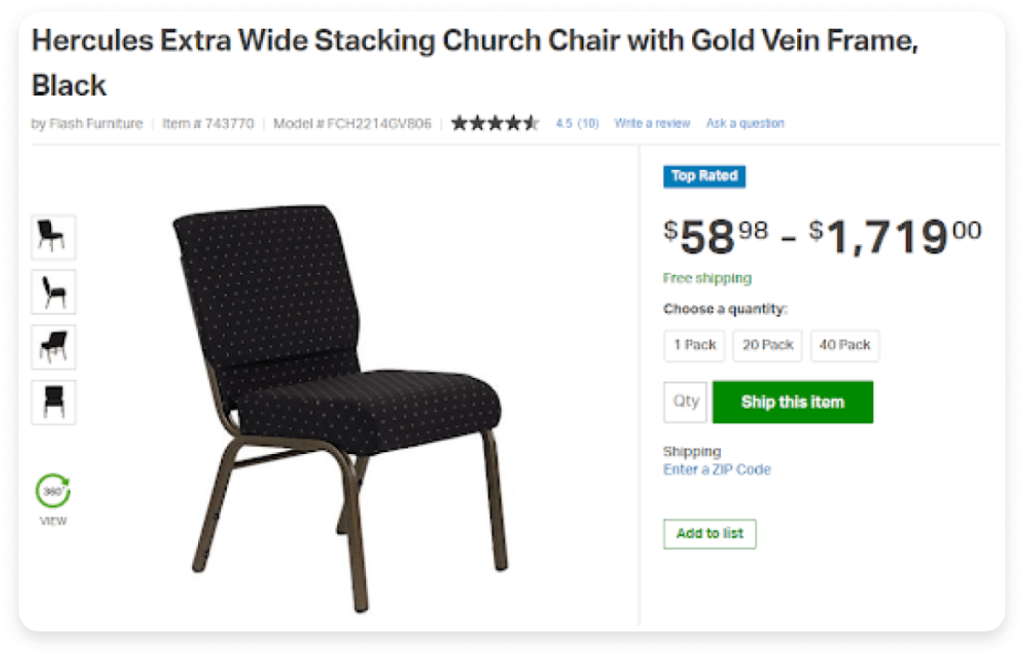
Overview: Flash Furniture was stuck in a single-customer rut, selling folding chairs one at a time to regular customers for about $59 each. Event planners, schools, and offices kept calling about bulk pricing but ended up buying from wholesale suppliers instead. Flash Furniture realized they could capture this B2B market with simple volume pricing.
Their Smart Solution: They realized they could win these bulk buyers with strategic volume pricing:
- Buying 1-9 chairs: Still $58.98 each (keeps regular customers happy)
- Buying 10-39 chairs: Price drops to $52.99 each
- Buying 40 or more chairs: Big discount to $44.99 each
The Transformation: Within six months, typical orders jumped from 2 chairs ($118) to 40+ chairs ($1,800). Event planners stopped shopping around and came directly to them.
Real Impact: Maria, a wedding planner, used to juggle three different suppliers with minimum orders and trade accounts. Now she orders everything from Flash Furniture. “I get wholesale rates without jumping through hoops,” she says.
Business Results:
- Bulk orders increased 400%
- Revenue jumped 85%
- Started competing with wholesale-only suppliers
- Large orders became easier to process than multiple small ones
The Lesson: A simple pricing change unlocked an entirely new market. No wholesale division needed, no complicated processes – just clear volume pricing that made sense to bulk buyers.
Tiered Pricing vs Volume Pricing: Which Strategy Fits Your Store?
Go with Volume Pricing if:
- You want something simple that customers instantly understand
- You’re selling to wholesale buyers who expect consistent pricing
- You need to clear out the inventory quickly
- Your margins can handle bigger discounts for higher volumes
Choose Tiered Pricing if:
- You serve both small retail customers and larger buyers
- You want to protect your profit margins while still offering deals
- You don’t mind a bit more complexity in exchange for higher revenue per order
- You’re willing to invest in an app or custom solution
Your Business Size Matters Too: Small stores often start with volume discounts because they’re simple and don’t require extra tools. As you grow and understand your customers better, you might switch to tiered pricing for better control over margins.
Large stores with diverse customer bases often use tiered pricing or even both strategies for different customer groups.
Final Words
The choice between tiered pricing vs volume pricing comes down to knowing your customers and your goals. Here’s the thing: you don’t have to pick just one forever. Many Shopify stores use tiered pricing most of the time, then run volume promotions during big sales events. So, the best tiered pricing vs volume pricing strategy is the one your customers understand and respond to. When they see clear value in buying more, everyone wins.